Saturday, September 16, 2006

Why isn't everybody offended by the Pope?


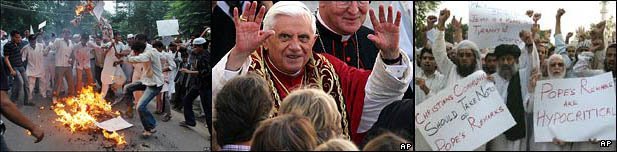
On Tuesday, September 12, Pope Benedict XVI delivered a speech, “Faith, Reason, and the University: Memories and Reflections,” that is in some way offensive to, or at least harshly critical of, Muslims, medieval Persians, secular humanists, Protestants, and pretty much anyone who identifies themselves as Christian but is troubled by the influence of Hellenistic thought on theological tradition.

The remarks against Islam have drawn the most attention in the past few days, terminating today in a statement from the Vatican, mildly apologizing for any offense to Muslims and asking that they consider the “true sense” of the papal words, (see the BBC for the text of the “apology”).

In my own consideration of the “true sense” of this speech, I found that the pope raised some interesting as well as startlingly awful points. Ultimately, the pope wishes to return religion and ethics to the study of communal reason. He fears that the future of the world is in danger because of the separation of scientific reason from questions about God. Only through the exercise of communal reason in consideration of God can a dialogue between cultures take place. In fact, in his view, secularists are largely to blame for many contemporary problems because they do not view religion as a field for the exercise of reason. One would think secularists would be up in arms over such an indictment.

The pope believes that the greatest difficulties for Christian thought are to be found among those who would divorce Christian and Hellenistic thought. He blames German liberal theologians, many responsible for his own training, and their pursuit of some original Jesus who correlates with their version of reason. He most fervently blames, however, the Protestants and their doctrine of sola scriptura for the divorce of reason and Hellenistic thought from Christian thought. I guess it's time for Protestants to cut ties with the Vatican.

The pope does imply some awful perspectives about Islam. In my view it is not the quotation offered from the Byzantine emperor about Mohammed that is most offensive, as the pope is actually quoting someone else. The pope then discusses the inappropriate, unreasonable use of violence by any religion. This is the basis for his argument that collective reason in the examination of religion is necessary for the future of the world and conversation between civilizations; that only religion examined through collective reason can combat a sometimes violent, but generally subjective view of religious ethics.

Most offensive here is that the pope implies, by using Ibn Hazn’s description of God, that Muslims (and some Christians as well) may view God as so radically transcendent as to be overly capricious. In the Pope’s view, Christianity is saved by Hellenistic thought, by the logos that signals the analogy between created human reason and the Creator Spirit. For the pope, God is reasonable, and so must we be also. The unstated implication in the phrasing is that the Muslim view of God (and the Protestant one for that matter – though not stated directly) is an unreasonable one. This is the most insensitive part of the Pope’s speech, in my view, the part that many would have had reason to be irritated by, the part for which perhaps the pope should even have apologized. Though this level of the pope’s speech requires you to have actually read it and it does not sound good when condemning him in sound bites.

Ultimately, the pope either poorly or pointedly chose the textual dialogues about Christianity and Islam that transpired between the Byzantine emperor Manuel II Paleologus and an educated Persian, Ibn Hazn. They probably took place in 1391, and we have the emperor’s version, so who knows what the biases are in the text. The pope’s decision here seems to be a poor one, used in service to a far more complex and interesting point (even if I disagree with much of his argument).

Yet the only thing that is truly offensive about the text is that Pope Benedict clearly believes Catholicism to be the best path. Then again, he is the leader of that tradition, so it would be shocking if he thought otherwise. As a leader of over a billion people in a world with deep and dangerous religious divides, the pope does need to be more diplomatic than the rest of us. It is right and fair for everyone to be critical of his views. Yet to demand an apology for such a speech is to demand that everyone who believes their religion holds the truth apologize for such a view. This is not only a ridiculous violation of the allowances of free speech, it is just patently ridiculous as long as people have different beliefs about God.

-----
The photographs above are taken from various BBC articles. The photograph on the left is of some Indian Muslims burning the Pope's effigy; click here for the picture of the Pope in the center; and click here for the photograph on the right of some Pakistani Muslims protesting the Pope's speech.

Friday, August 25, 2006

Life as a checked-box


It’s okay to be racist; it’s just “ethnic pride.” According to CBS that is. I guess I was asleep and missed the pop culture cues on that one. This fall, the reality show that defined a genre has decided to split 20 contestants up into four ethnic groups: “African-American,” “Asian-American,” “Hispanic,” and “white.” The terminology makes me think I woke up in a bad parallel 1982. I suppose the show’s producers forcibly removed the “Native American” team before filming began while they were too busy pretending there are no “Middle Eastern-Americans” in the USA. Listening to NPR’s ”Day to Day” this morning, I learned that the producers of CBS’ Survivor: Cook Islands rationalized their “race-baiting”, attention-grabbing “social experiment” on the basis of just having interviewed people with a lot of “ethnic pride.” Since half of them admit to be actors, that sounds a little fishy to me. With ethnic- or religious-based civil wars raging in large swaths of the world, it seemed like a good time to divide people up over “ethnic pride.”

Really, it’s okay that “corporate America” wants to convince us that racism is “so last year” that it’s “all good” for people to identify with labels and supposedly root for a team based purely on their sharing the same ethnic background. Of course, all of us multiracial/multicultural, Native-American, and/or Middle-Eastern-American people will just have to watch other shows this season. But I’m not sure what since the new racial divide haunts me wherever I go. Last Sunday’s Comedy Central Roast of William Shatner contained a plethora of racist and homophobic humor (like George Takei’s difficulty saying “glory hole” because of his Asian accent, which last I heard had the perfected pronunciation of a Shakespearean actor, but I guess I slept through that too). Here’s a novel idea. Maybe I should just turn off my television because by now I’ve learned I’m not really part of the target audience for anything anyways.

Of course, listening to the news I realize that this pop cultural joke is not relegated to poorly conceived television shows. Apparently the Bush administration believes that certain regulations are no longer necessary. Even worse, they keep people out of schools “because of their [white] race.” As Survivor proves, we have clearly solved the difficulties around race in this country.

Friday, July 28, 2006

Fat Momma is here to save the day


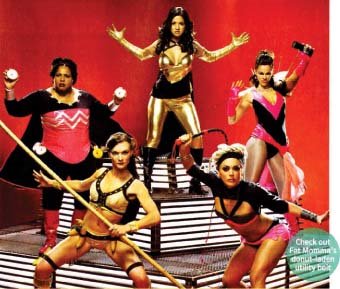
Despite reality television’s ever expanding grip on our attention spans, I was pleasantly surprised last night when I took a break from my normal Thursday evening to watch Sci-Fi channel’s new reality television series, Who Wants to Be a Superhero? I admit to having been skeptical of the idea that you could create a reality show about people who wish they were comic book characters, but the premise of the show is actually quite charming and all the characters quite amusing (including my favorite, “Fat Momma,” whose weakness is diet food). These people are not competing for lots of money; they are competing for the adaptation of their own idea of a superhero by legendary superhero-creator Stan Lee.

That was not the only thing that I liked better about that show than a normal episode of Fear Factor or Survivor. The first two eliminations were truly based on whether each individual could indeed offer the super-person qualities requisite for a superhero. In the first round, all the would-be superheroes were spied upon to determine whose motives might not match the selfless demands of a superhero’s existence. In the second round, all the contestants were told their challenge would be to change in a private place into their superhero costume and get to a finish point as fast as possible. The challenge was actually if they would stop what they were doing to assist a girl crying for help just before the finish line. The unfortunate reality of this reality show is how most of the would-be superheroes ran right past the girl. The terrific thing is that the ones who stopped to help (Fat Momma, Lemuria, Cell-Phone Girl, and Major Victory) were all guaranteed safety in the next elimination round. Whatever my complaints about reality television, it is nice to see a competition that tries to reward people for being better people. In theory, this reality show cannot be won by scheming, manipulation, stabbing people in the back, and being the most outrageously irritating person around. It will be quite interesting if this six-episode show does continue to be the foil of the reality TV I’ve come to expect.
----
Image taken from Sci-Fi.com (from TV Guide)

Saturday, July 22, 2006

Being a bad friend


I've always said that I want the type of friends who would tell me when I have food in my teeth or a booger hanging out of my nose. A good friend is one who is willing to tell you the truth about what you do.

The USA has not been a good "friend" to Israel in a long time. These past two weeks, however, mark a completely unacceptable turn in the ridiculous alliance of these two nations. If you are to believe Ted Koppel's editorial in yesterday's New York Times, then Israel is a puppet state fighting Iran for us through their puppet of Hezbollah. If Israel is doing this of its own accord, it is a crazy attack that has cost so many civilian lives while merely strengthening the support of Hezbollah in Lebanon. A good friend would tell Israel that attacking Lebanon is probably a long-term bad idea, but instead the USA is speeding up its shipments of weapons.

But maybe the USA does enjoy the idea of spreading theocracy throughout the Middle East.

For a good batch of editorials on the current Israel-Lebanon conflict, you should take a look at today's New York Times which has a diverse array of views.

Also, if you're interested in learning more about the Mearsheimer/Walt article that spoke of the dangers of the Israel Lobby to the USA's own foreign policy, I would like to recommend a set of links that give food for thought on the relationship between the USA and Israel.

The London Review of Books contains an abbreviated version of the Mearsheimer/Walt article, and it includes a link to the full paper if you wish to read it.

The New York Review of Books' Michael Massing published a review not just of the article but of the controversy surrounding it, and he is critical of most of the article.

The most compellingly non-reactionary critique of the article is probably from Noam Chomsky.

Mearsheimer and Walt also published their own summary of the controversy and response to their critics.

----
The photograph above comes from The New York Times' Tyler Hicks, and it shows leaflets dropped by Israel in Southern Lebanon in an attempt to warn civilians to leave.

Tuesday, June 27, 2006

I believe it is about the essay


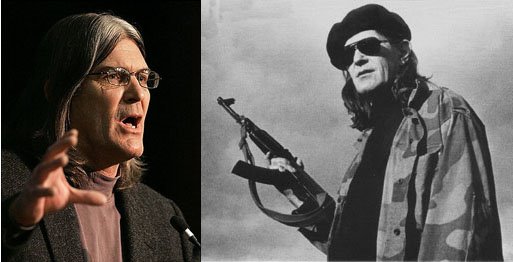
I am just adding my voice to the chorus on this one - Ward Churchill may not be someone I agree with, or can even support, but the academy has joined the rest of the country in walking the knife's edge.

On Monday, the interim chancellor of the University of Colorado, Phil DiStefano, recommended the termination of Churchill's position at the University of Colorado. Consequently all his teaching and research duties have been ended, though he is still being paid until the Board of Regents makes its final decision. (For more in-depth coverage, you may check The New York Times , The Rocky Mountain News, and, on a different note, Inside Higher Ed.)

What is interesting to me is that the faculty investigating this noted themselves that Churchill was hired and promoted by a university who knew he was an activist and that he has not been traditionally credentialed with either a Ph.D. or J.D. For years, allegations of research misconduct had flown around Churchill's work. Yet it is when his opinions draw national attention and disdain for being "unpatriotic" that an investigation is convened (though DiStefano pleads that one has nothing to do with the other). The faculty on the committee were themselves divided on how Churchill should be punished with only one of the five members recommending all out dismissal and termination of tenure (you can see the faculty's own reports on the University of Colorado's website).


DiStefano's call for Churchill's dismissal is now a sad academic mirror of the criticisms of free speech plaguing the country. Just this week, President Bush himself joined a chorus of conservatives condemning The New York Times for actually reporting news to the U.S. public (check out the Canadian perspective here). Not unlike Churchill, The New York Times has made some serious mistakes before, but actually reporting real news isn't one of them. Of course what do you expect in a country where press freedom is lower than that of the bulk of the Western world (including my favorite countries in the Western hemisphere, Costa Rica and Canada - see here for more information on the USA's low ranking)?

-------
The image of Ward Churchill on the left is taken from the Washington Post article. The image on the right is from Satya.

Wednesday, June 14, 2006

Sometimes you just need a little Nietzsche


"Wer mit Ungeheuern kämpft, mag zusehn, dass er nicht dabei zum Ungeheuer wird. Und wenn du lange in einen Abgrund blickst, blickt der Abgrund auch in dich hinein."

(Translation: Whoever fights monsters should see to it that in the process s/he does not become a monster. And if you gaze long enough into an abyss, the abyss will gaze back into you.)

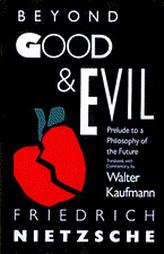
Friedrich Nietzsche, Jenseits von Gut und Böse (Beyond Good and Evil: Prelude to a Philosophy of the Future), Aphorism 146.

Thursday, June 01, 2006

Sayonara Amendment One


"Amendment I

Congress shall make no law respecting an establishment of religion, or prohibiting the free exercise thereof; or abridging the freedom of speech, or of the press; or the right of the people peaceably to assemble, and to petition the Government for a redress of grievances."


On Tuesday, the Roberts (with Alito bonus player) Supreme Court made another landmark decision. Landmark that is if you are on the side of government being protected from whistleblowers. They decided that Richard Ceballos, once deputy district attorney of Los Angeles, had no right to query the affairs of his office in his official capacity as deputy district attorney. Rather, somehow, he can only do this if he holds a public press conference as a private citizen, not in his position as an advocate of justice advocating, well, justice.

This decision is, as The New York Times argued, a break with previous precedents, one of which was even set under the Rehnquist court of 1979. It is also, of course, a decision that likely would have been different had one of the presiding justices been Sandra Day O'Connor and not Samuel Alito. (As a sidenote, I thoroughly enjoyed the brief commentary on this to be found at The Right Honorable Samuel A. Alito, Jr. Blog.)

This decision of this Supreme Court just underlines the Bush administration's control over the Judicial branch. It is an administration who has already violated the Fourth Amendment in its NSA search through the phone records of countless private citizens. Now, its Supreme Court, which will long outlast the Bush administration itself, is in the process of taking apart basic First Amendment protections that would allow an individual to pursue justice through official capacities.

The irony is that this comes just after a time when many immigrants to the USA were joined by allies, many of whom are also of immigrant background, as they actually exercised their First Amendment rights to peaceably assemble and petition this government for a redress of grievances.

While I think the pro-immigration protests were a great thing, I would really like to know what is wrong with us that immigrants can turn out in droves and liberals can turn out in droves for immigrants, but we can't turn out in huge numbers when the most fundamental freedoms guaranteed by our Constitution are being taken away from us.

-------
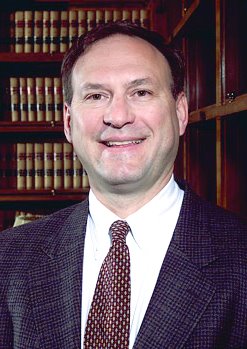
The photograph of Samuel Alito when he was a justice with U.S. Court of Appeals Third Circuit is from Wikipedia.

The image of the First Amendment to the USA Constitution is from The National Archives "Charters of Freedom".

The transcript of the First Amendment is taken from The National Archives as well.